
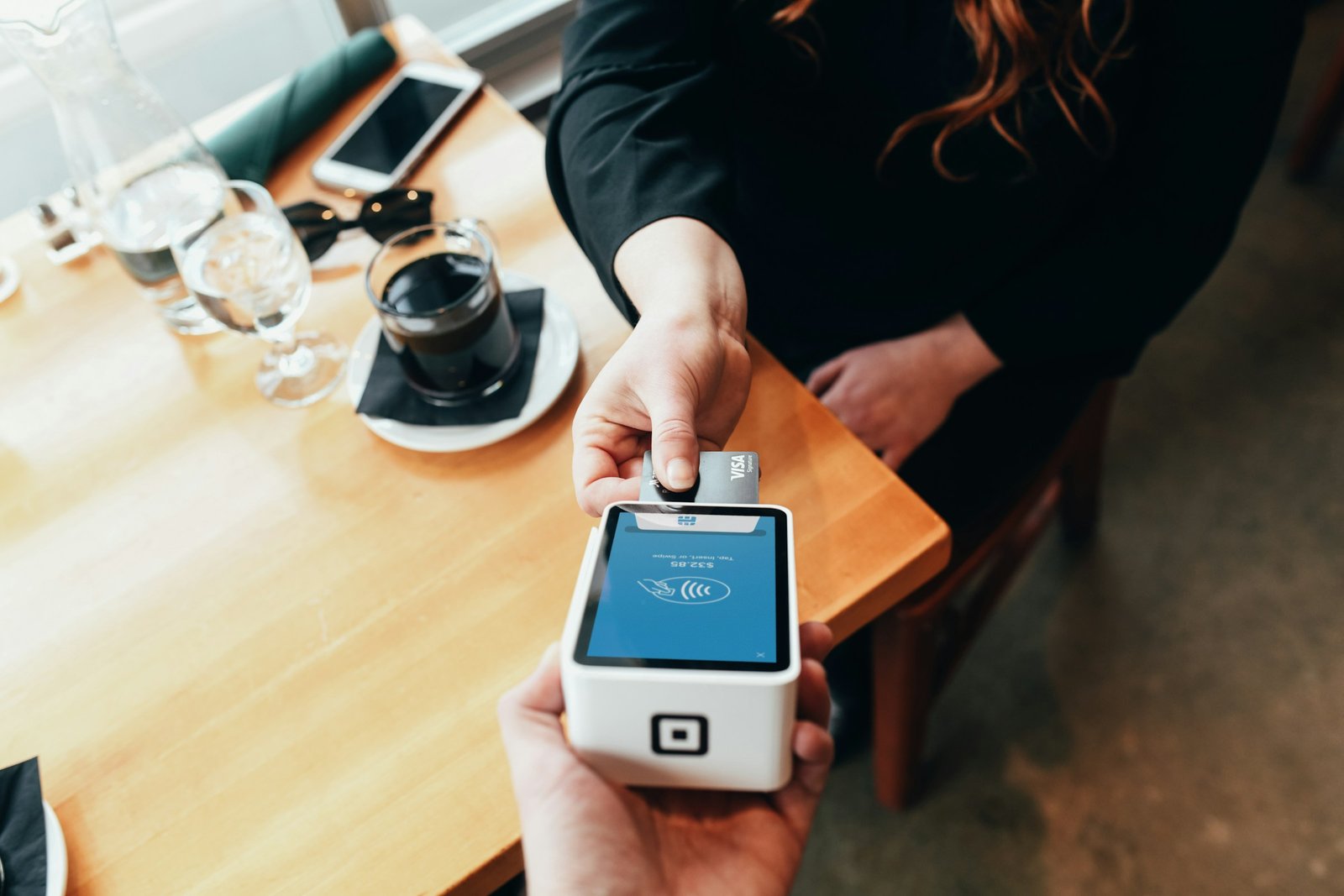
Square’s advertised rate is one number, but what actually lands on your statement depends on how the card was accepted, online, in person, typed in manually, and which Square plan you’re on. This is Square fees explained with the real numbers, straight from Square’s own pricing page, and what actually moves that total for a typical small business.
Last verified: August 2026.
Square fees explained by transaction type
| Transaction type | Free plan | Plus plan | Premium plan |
|---|---|---|---|
| Tap, dip, or swipe (in person) | 2.6% + 15¢ | 2.5% + 15¢ | 2.4% + 15¢ |
| Online checkout or invoice | 3.3% + 30¢ | 2.9% + 30¢ | 2.9% + 30¢ |
| Online, via API | 2.9% + 30¢ | 2.9% + 30¢ | 2.9% + 30¢ |
| Manual entry or card on file | 3.5% + 15¢ | 3.5% + 15¢ | 3.5% + 15¢ |
| ACH bank transfer (invoice) | 1%, $1 min | 1%, $1 min, $10 cap | 1%, $1 min, $10 cap |
| Afterpay | 6% + 30¢ | 6% + 30¢ | 6% + 30¢ |
| Cash or check | Free | Free | Free |
These are the standard published rates as of August 2026, confirmed directly on Square’s fee page. Square Premium isn’t a fixed monthly price, it’s a plan whose exact cost depends on your business, so the lower processing rate has to be weighed against what that plan actually costs you monthly.
Why the rate changes depending on how you take the payment
The gap between 2.4% and 3.5% on the same table isn’t arbitrary, it tracks fraud risk. A card tapped or inserted in person is the lowest-risk transaction because the physical card and often a PIN or signature confirm the buyer is who they say they are. A card typed in manually, over the phone or from a saved card on file, carries no such confirmation, so it costs more to process. Online checkout sits in between, verified by the card network’s own fraud tools but still remote.
This is why a service business that takes a lot of over-the-phone payments pays a meaningfully higher blended rate than a retail shop swiping cards at a counter, even on the exact same Square plan.
What actually determines your total cost
- Your transaction mix. A business that’s mostly in-person card-present sales pays close to the 2.4-2.6% rate. One that’s mostly online or phone orders pays closer to 2.9-3.5%. Your real blended rate is somewhere between those, weighted by how your sales actually split.
- Average ticket size. The flat per-transaction fee (15¢ or 30¢) matters more on small tickets than large ones. A $5 sale loses a bigger share of revenue to the flat fee than a $500 sale does, so a high-volume, low-ticket business should pay closer attention to the flat-fee side of the rate than the percentage.
- Which plan you’re on. Moving from Free to Plus or Premium lowers the percentage on card-present and online transactions, but those plans carry their own monthly cost. The math only favors upgrading once your processing volume is high enough that the fee savings outweigh what the plan itself costs.

Where businesses get surprised
Manual entry costs more than people expect. Keying in a card number, whether for a phone order or a customer who forgot their card, jumps to 3.5% + 15¢, a full percentage point above card-present. For a business that does this often, it adds up faster than it looks like it would on any single transaction.
ACH isn’t free, but it’s close. At 1% with a capped fee on the higher plans, ACH bank transfers cost a fraction of a card transaction, especially on larger invoices. For any invoice north of a few hundred dollars, offering ACH as a payment option meaningfully cuts what you pay to get paid.
Afterpay costs the most by far. At 6% + 30¢, buy-now-pay-later is roughly double a standard card rate. It can be worth it if it increases how often customers complete a purchase, but it shouldn’t be treated as a normal payment method cost-wise.
For how these pricing models work across any processor, not just Square, see our full breakdown of payment processing fees.
Square’s flat rate vs interchange-plus pricing
Square uses flat-rate pricing: one published percentage plus a fixed fee, the same regardless of which specific card network or card type the customer used. That’s the appeal, no surprise interchange categories to track, no statement full of line items to decode. The tradeoff is that flat-rate pricing bakes in a margin on every transaction, including the lower-cost ones.
Interchange-plus pricing, the model traditional payment processors use, passes through the card network’s actual interchange cost (which varies by card type and how the transaction is accepted) plus a fixed markup on top. At low to moderate volume, flat-rate pricing is usually cheaper and definitely simpler. At high volume, especially with a transaction mix weighted toward lower-interchange card types like debit, interchange-plus can end up cheaper, the tradeoff being a statement that takes real effort to audit.
For most small businesses processing under six figures a year, the simplicity of flat-rate pricing outweighs the marginal savings interchange-plus might offer. The math flips as volume grows, which is part of why Square itself routes businesses over $250,000 a year toward custom pricing instead of the published rates.
Processing fees are usually the single largest line item behind whatever your software subscription costs. For the full picture of what a small business actually spends across software, payroll, and payment processing combined, see our complete guide to small business software costs.
How to lower your actual rate
The biggest lever most small businesses have isn’t negotiating, Square’s rates are largely fixed and published, it’s shifting the mix of how payments come in. Pushing more transactions to card-present instead of manual entry, offering ACH for larger invoices, and choosing a plan that matches your actual volume are the three changes that move the needle. Chasing a lower advertised percentage without looking at your actual transaction mix rarely saves as much as it seems like it should.
Frequently asked questions
Does Square charge a monthly fee just to use it?
The Free plan has no monthly software fee, you only pay processing fees per transaction. Plus and Premium carry their own monthly cost in exchange for lower processing rates and more features, so which is cheaper overall depends on your volume.
Is Square cheaper than a traditional merchant account?
For most small businesses, yes, because Square has no monthly minimums or long-term contracts. At high volume, a negotiated interchange-plus merchant account can end up cheaper, the crossover point depends on how much you process monthly.
Why did my Square deposit come in lower than expected?
Check which fee applied to that specific transaction, manual entry and online payments cost more than card-present, and a batch of mixed transaction types will show a blended rate that’s easy to misread as a single flat number.
Does the processing rate change if I process a high volume?
Square states that businesses processing over $250,000 per year can talk to their sales team about custom pricing. Below that threshold, the published rates on the Free, Plus, and Premium plans apply as listed.
This site is independent and is not affiliated with, endorsed by, or sponsored by Block, Inc. or Square. Square® is a registered trademark of Block, Inc. All product names, logos, and brands are property of their respective owners.